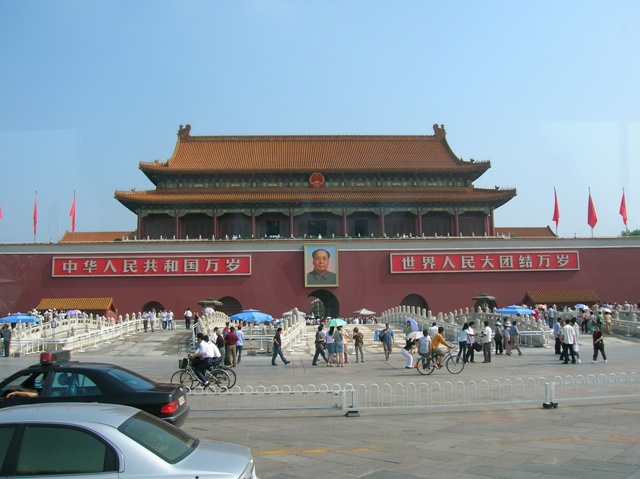
26 July 2006

Leaving Xian for Chengdu (in the Sichuan Province) - 11 July 2006

We got our wake up call at 4:30 am, which is just so very early in the morning. (I suppose I could comfort myself with the idea that it was 4:30pm the previous afternoon on the East coast?) Xi'an had no traffic at all at that time. The city was barely waking up. At the airport check in was so easy, and there was hardly anyone there either, which was in stark contrast with the Beijing airport.

We arrived at the Chengdu airport around 9:30 am, I think and we were all definitely ready for a nap, no question. We got on our bus and were taken into the city, and we checked into our hotel, which was right across the street from an enormous Crowne Plaza Holiday Inn (I didn't realize those two companies were connected, I never really thought of them as being in the same class of hotels). Our hotel is right around the corner from a pedestrian mall/shopping area. Basically it's outdoors - as if they took all the stores in a mall and removed the walls and roof.


We went to lunch, and our first Sichuan food experience was not a success. Let me start by saying that Sichuan (you may be more familiar with it as Szechuan) province is VERY hot, and the food is as well, because, as our guide explained: "In order to get the sweat, you have to eat the hot, spicy food." However, they don't just do hot, spicy food in Sichuan. The very first dish they put down in front of us was chicken feet. Then they followed that with a bowl of tripe. Um, yum. I did not taste the chicken feet, I'll be honest. They looked like chicken feet, and were plae white and kind of pimply. I was willing to try stuff, because hey, half the reason we were there was for a cultural exchange, but they were chicken feet. Someone in our group did try them, and she said that they tasted just like you'd expect them to: like knuckles. Again, mm, yum. There was also some kind of pale green bumpy thing which they said was bitter herb. One person at our table tried it, and he said it was really bitter indeed. There was edamame, which I actually kind of liked - I didn't know they were a form of soy bean until later, but that was definitely something to try again in the future. There were a number of very spicy dishes that were so spicy that I couldn't eat them, and there was a dish of what they called bullfrog, which I actually thought was pretty good. It's hard to describe it, but it has a similar texture to crab, although the flavor isn't quite as strong. There were also a number of dumpling type foods that were quite good. They also had a bunch of bean curd/paste things that were really sweet, although they were brought out in the middle of the meal. Generally, the Chinese don't really do desert, although they do have these sweet courses in the middle of the meal. You always know the meal is over when they bring out the watermelon. However, that hasn't stopped Haagen Dazs from opening several stores in China - one in Chengdu and one in Beijing (that I saw - there could have been more, but I didn't see any).

After the meal we went to the Sichuan Province Department of Education, even though we thought we were going to have a free afternoon. I don't know if I said it, but in China there are three levels of control over education: National, provincial and local (cities, villages). In all honesty, I didn't get a whole lot out of the meeting with the dept. of ed folks, because I was so tired, but also becuase there were translation problems. Our guide, Jim, didn't know he was going to have to translate, so he was unprepared to do it. Plus it's really hard, I would imagine. I also think that some of the numbers and details we got weren't entirely accurate.

What I did learn that was interesting was that Sichuan has the second largest Tibetan population outside of Tibet and 75% of the population in this province is rural. They also have a much smaller teacher/student ratio (about 1 to 22, which is more than half what it was in Beijing or Xi'an, where it was about 1 to 50 or 60). I wonder how much of the rural population is really attending school.
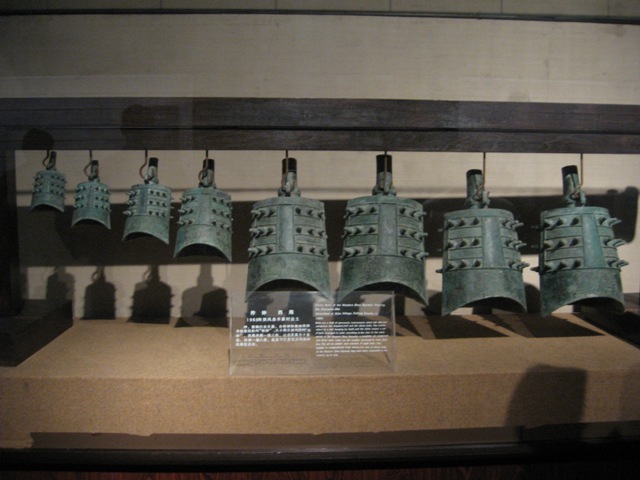
Shaanxi Provincial History Museum

We were supposed to go to this museum on the previous day, but for some reason we didn't - I think it had something to do with the bus. I'm not sure which day we went, but it may have been the 9th. Anyway, the museum is organized chronologically, and by dynasty. The exhibits are comprised mostly of artifacts from each dynasty, and they actually go from prehistoric times. They did have four terra cotta soldiers so you could see them from close up, which was neat, plus some kneeling figures from Qin's tomb. There was a lot of stuff from the Tang dynasty, especially the tricolor pottery stuff that they are best known for. They didn't have a lot of the stuff that I consider typically Ming - the blue and white vases, in fact they only had one. I think this is partly because the museum focused primarily on stuff found in Shaanxhi Province and the Ming and Qing dynasties had their capital in Beijing, whereas dynasties like the Qin, Han and Tang all had their capitals in Xi'an. I felt like there should have been more stuff there, but it was a nice museum in the end. There wasn't a whole lot of written history (but what they did have was both in Chinese and English, which was cool) for us to read, but the stuff was pretty neat:

Pictures! How do you know for sure you're in China?

When you see this:


12 July 2006

University of International Studies, Xian

The University of International Studies in Xian is about 20 minutes outside of the city, maybe a little further. it is an enormous campus that is actually surrounded by several other enormous schools. This school specializes in foreign languages. We strolled around the campus a bit, and then met with the dean of the English department. He had some interesting things to say, but I was most interested in how he got his job. What I've noticed is taht there are lots and lots of people working everywhere. We went into a coffee shop, and there were about six people working there. it seemed as if one or two people took orders and made the drinks, while the other 3-4 stood around, cleared tables, etc. There are always people cleaning the streets (essentially by hand, or with brooms), and usually several per block. In fact, they often will have an umbrella under which to stand when they aren't cleaning the streets.

So my question is this: How do people get their jobs? Are they assigned to a particular field? A specific type of job? Do they choose? The dean said where he had worked, but hadn't really explained the process of how he got the jobs in the first place. This will have to be determined at some point!!

In the afternoon, we went to another Key School (these are the showcase schools). This was another high school, and it had many campuses around Xian. It is obviously very wealthy, or at least, someone put a heck of a lot of money into it, as have all the school we've seen. We had an opportunity to talk to some students, which was VERY cool, and as always, my favorite part of these trips. It's a shame that most of these schools are out for the summer, and we won't be able to talk with asw many students anymore.

The young woman I spoke with had chosen Helen as her American name, because she thought Helen Keller was "cute". I'm not sure what she meant by cute, but I'm thinking it's not the same as what we mean by cute.

We talked a little bit about her school and what she was studying (biology, chemistry, physics, English, Chinese, PE (yes, that's what she said), and computer science). She like computer science and English the best. She also said she had a hard time with English at first because she couldn't figure out the tenses. Apparently they don't have tenses in Chinese the way we do in English, so she spoke "always in the present tense."

We got started on Harry Potter - she's read them all, some in both English and Chinese. She is very mad at Snape right now, but I told her (thanks, Jason and Doug!) that we have to trust Dumbledore. (A little somethin' for the HP fans)

Anyway, that was definitely the highlight of the afternoon. We went to see the other campus of the school (big, wealthy, stuff, very little in the way of student work, except in the art room). It bothers me greatly that there doesn't seem to be a coherent history or Social science program in Chinese schools. In seems to be done sort of as an aside in both English and Chinese, but not at all in the way we do it. (which isn't necessarily a bad thing, btw, just a different thing) I also thing there is a lto more focus on pre-1911 history (pre the fall of the last Imperial dynasty) than on history since 1949 (beginning of what they call "new China"). Now in theory, one could argue that our hsitory classes, function similarly, but I think there's a great distinction there. We tend to teach our history warts (pimples might be more appropraite in contract with China's 5000 year history) and all, and I don't think that's really done here. A lot of people still seem to really love Mao (while many also seem to dislike him intensely, let's look at that too). Anyway, I'm still baffled. They seem very, very proud of their ancient past. The Tang dynasty (618-907 CE, if this History & Civ of China book is to be trusted) comes up a lot as the Golden Age of China. It is a puzzle to which I don't believe we'll get a satisfying answer.

Hot Springs/Huaqing Pool

After the T-C warriors, we went to the Hot Springs (over 100 degrees plus that day, no less. Nothing says "cool" like some hot springs). It turns out they were no longer in use, just a shadow of their former selves, as the case may be. They were used mostly by the Tang emperors (and empresses), and were actually in quite a beautiful setting at the base of a mountain. Chiang Kai-Shek stayed there during the 1930s and set up headquarters there. They so called "Xian incident" occurred here. It's a bit confusing as to what it actually is, based on the references I have here, which includes a "History and Civilization of China" book published in China. Based on the language, it's a direct translation from the Chinese (it's quite an atrocious translation, actually), and there's definitely a pro-Communist bias (shocking, I know). As near as I can tell, the Xian incident is a struggle between Communist forces and nationalist forces, all of which occurred at the same time the Japanese were in China. There was a lot of consternation about the lack of attention being paid to that fact among both the Nationalist and Communist forces, as well as the Soviets. (Japanese forces in China could have been a prelude to invasion of the Soviet Union, something they had been worried about since at least 1905 and the Russo-Japanese War.) Not very informative, I know, but it's kind of difficult when most of my options are in Chinese, and are ... shall we say a little biased? Take the following as an example:

"In June 1946, because of the perfidius Kuomintang, an all-out civil war broke out." (p. 232, The History and Civilization of China. Can't tell author, it's in Chinese!) The italics are my emphasis.

Anyway, you see the dilemma.

Terra Cotta Soldiers

The day we went here it was INCREDIBLY hot (actually, the guide book says that Xian is "bloody hot"). It was about an hours drive from our hotel. The soldiers were found by four peasants who were digging a hole for a well in 1974. They had the foresight to stop digging and contact some kind of authority to say "Hey, we found something!"

When you enter the parking lot there is an enormous statue of Qin Shihuang (1st emperor of Qin). We walked about maybe an eighth, maybe a quarter of a mile to the actual museum and the sites of the digs. They are still in the process of digging out all of the soldiers, but they think there may be as many as 7,800 in all. Qin Shihuang (not easy to type!) was apparently obsessed with his death (the idea of it), and had people start constructing the tomb well before his death. One reason for this obsession may be that he was an unusually cruel leader (well, ok, let's think about that, maybe he was just a wee bit worse than usual for the time, which was about 210 BCE), as was his son. The Qin dynasty was one of the shortest dynasties.

Once you enter the main park there are three main buildings. The one straight ahead contains the bulk of the soldiers. They are mostly facing eastward, because Qin Shihuang thought his enemies would come from that direction (perhaps he meant us?). As with everything in China, this main building was crowded at first. The first pit/vault is so large that even though there are large numbers of peole, it's actually possible to spread out and get a little personal space (a difficult thing in China. The concept of personal space here is verrrry than in the US). We entered the pit and most of the soldiers were facing us, although some are facing sideways. (I don't know why, so please don't ask) The picture everyone wants is the one where you face the whole pit. It took a ton of pictures, and I think some of them came out ok. I tried to get individual faces, because apparently each soldier is modeled on the faces of the builders. It was difficult because so many people kept bumping into me. In fact, at one point I was kneeling down to take a picture of one of the group of soldiers, and a tour guide backed over me. He was concentrating on whatever he was talking about with his group.

What is amazing and astonishing is not only the sheer number of soldiers, bt the fact that so many of them are still in such good shape. Ok, sure, so many of them are missing heads, and some of them are missing their hands, and they are all missing their weapons, but don't forget, these guys are over 2,000 years old.

The whole experience is kind of surreal, actually. Here's this emperor who manages to unit feudal China, who orders the building of his mausoleum to begin as soon as he becomes emperor. Besides the Egyptians, who does that? You'd have to be pretty damn morbid to have that be your focus. Of course, as I'm writing this, I'm reading about this in the book I bought at the shop ("Awakened: Qin's Terra Cotta Army", Shaanxi Travel and Tourism Press), and I see that later dynasties did this practice too (Han, Tang). I guess when you live in dangerous times and your empire could be overthrown by peasant revolt at any minute, this is probably a prudent course of action.

Qin Shihuang's tomb is actually 1 and a half kilometers to the west. Legen has it that Qin built his mausoleum with a river of mercury in it and arrows that would shoot out of the walls to protect against theives. Since the Chinese government isn't certain about whether or not this is true, they are moving very slowly on the excavation of the tomb. A river of mercury after 2000 years has got to be detectable in the environment, doesn't it?

Some stats about the tombs: (sorry for the metric)

Vault/pit 1: 210 meters long, 60 meters wide. About 6000 soldiers in vault one. Not all have been unearthed (it's an active archaeological site, although we didn't see anyone working when we were there).

Vault/pit 2: 1000 figures

Vault/pit 3: 68 figures, one war chariot

I did mention I had a ton of pics, I'll bore you with them when I return.

Xian

This is really the end of the world – the Silk Road ends (and I suppose, begins) here. At least according to the Chinese. There’s a statue facing west that marks the beginning of the Silk Road. The statue is of a general, and don’t ask me what his name is because I don’t know – they told us on the bus on the way from the airport, and I didn’t have anything to write with at the time. The central part of the city is surrounded by a wall. The wall was built on the foundations of the old walls of the Tang dynasty forbidden city (more on the Tang later, REALLY) by the Ming dynasty. It’s quite a thick wall (two chariots can drive abreast on it, should they choose. And if you happen to have a chariot handy, I suppose), and pretty high as well. (have pics, I think). Our hotel looks out on a portion of the wall, and we actually have a great room right in the front of the building on the 7th floor, so we can see all sorts of things from here. Every night they have what can only be described as a big conga line party. It’s basically a big dance party that goes around the park for hours and hours. Well, it’s probably not as long as all that, but it seems like it goes on for hours. Luckily I’m still so exhausted in the evenings that basically I get into bed and I try to read my book and I can’t keep my eyes open. Next thing I know it’s morning. As I type, they are out there right now partying up a storm.

Xian has a relatively large Muslim population for China (the Hui people). Apparently, Xian also has a large Christian population. Inside the wall in the older part of the city is an interesting combination of ultra modern and ultra expensive stores. They have a fancy schmancy mall that reminds me of Tysons II. Ferragamo, Louis Vuitton, Givenchy, Versace and Ralph Lauren. You get the idea. Further on down the main road is the Bell Tower. It was built in the 14th century and then rebuilt in 1739. They ring the bell at about 8 o’clock each night, and you can hear it from quite a ways away over the din of the city. It is quite a deep sound. If you walk a little further beyond the Bell Tower off to the left is the Drum Tower. It is smaller than the Bell Tower, and marks the Muslim Quarter. There is an alleyway off from the tower that is called the “Muslim Market”. There is stall upon stall of Chinese crap. (have pics) Mah jong sets? They have about fifty billion. Mostly those are plastic crap, although some people are claiming they are bone and bamboo. They have lots of stalls with Chinese art, some of which is really nice, and some of which is not. There are lots of silk pillow covers, which I am quite tempted to buy, but I’m afraid I’ll get a gorgeous one that won’t go with my couch, so I think I’ll just not buy one. There was one thing we looked at today that I was SOOOOO tempted to buy. It was a lighter with Mao’s picture on the front. When you opened the lighter, it starts playing the anthem. You can buy just about ANYTHING you want with Mao’s picture on it. Not sure how that goes along with the whole communism thing he tried to get going, but I have a feeling he’d probably think that this was cool. Actually, I know he would – he would totally dig the fact that his face is on every piece of kitsch in China. What is incredibly disconcerting about the Muslim market is that you cannot touch anything without a vendor coming up to you and saying “You like, give you good price. Cheap. You name price.” It’s getting to the point where I’d really like to go somewhere without having someone come up to me and offer to give me a good price. Several times when I was looking at the silk pillow covers, the vendor would come up to me and start a running commentary on what was on the cover. “Bamboo”, “flowers”, “birds”. It’s a bit odd. You have to haggle for everything, and I’m just not sure if I’m any good at it. At this point I think that things are cheap enough that it really doesn’t matter, but you have to haggle no matter what. They offer a price, and you have to offer half, and then they offer a price, and so on. I hate it, really. I never really know when to stop, or when it’s appropriate. I’m sure that I could have gotten better prices for a lot of the stuff, but there’s nothing I can do about it now.

11 July 2006

Chengdu

Arrived safely in Chengdu. Surprisingly, it's a much larger city than I think any of us had been expecting. It reminds me of New York in a lot of ways - especially this morning when I went out at 7:30 to Starbucks (I was desperate, ok?). At any rate, not much time this morning, because we're off to Chengdu Normal University (I think) in a little while. Apparently in what can only be Chinese logic, I can't access my e-mail, but I can access blogger. I will update with more stuff later, I have a ton of stuff to post.

4 July Geely University

Geely Automotive University is about is about an hour and a half outside of Beijing by bus. It seemed to be really far away, but traffic was really horrible, as we’ve come to expect from Beijing. They have about 20,000 students, and expect about 10,000 more to enroll next year. They recruit their students, and are a private university. Geely automotive group is a (shocking, I know) car manufacturing company. Their cars look a little bit like Toyotas (ok, that may be blasphemy, but it’s the best I can do on such short notice). They have invested their profit into creating this university, which has 16 colleges/schools, including the following:

a. Euro-American colleges (specializes in training young people to go abroad to further their studies)
b. Foreign language school
c. Law
d. Finance
e. Journalism
f. Automobile building (natch. One would HOPE that there would be an automotive school in a university funded by an automotive company!!!)

Geely means “Great Fortune” in Chinese, and with good reason. The campus is quite large, and it is vastly undeveloped at the moment. They are in the process of building their library, which has a distinct resemblance to the Capitol building in DC. I’m not sure if I got a picture of it…in all honesty, I am writing this days after the visit, and so my memory of the event is a bit fuzzy. I did take notes, so no fear, dear readers.

Geely is a private and independent car company, a rarity in China, to be sure. Most other companies work in a joint venture with the government. I think most businesses in China are still joint venture, although many more are becoming private, I think. The leader of our group, Jian Wang, is one of the founders of the university, along with the Vice President, Professor Chen. Prof. Chen spent two years at Cornell University in Ithaca, NY, and his English was excellent. Prof. Chen was among those who were to be “re-educated” by the Red Guard and his own students during the Cultural Revolution. What I find interesting about many of these experiences is that the people who were affected by this (Jian is one of those, more on that later), often will mention what happened to them in a casual way and then not want to discuss it any further. I completely understand them not wanting to discuss it, but I’m kind of surprised they’d mention it at all, especially given how private so many people are here. Anyway we got a ton of statistics about university life in China, and I promise I won’t bore you with them.

We did learn some interesting things about Chinese language instruction: in the 1950s and 60s, Chinese language instruction was really disjointed – you learn a particular set of things at the primary level, and then when you go onto the next level, you go back to the beginning, and so on and et cetera. (Sound familiar?) Zhou Enlai (who is quite revered in China… more on him later), said that language instruction in China needed to follow the “One Dragon” approach – you start at the head and continue in an organized fashion to the tail, making sure that it’s all connected and that it makes sense. I thought this was wonderful, and BOY do we need that in the States. And not just for language instruction, but for history instruction as well. Why is it, exactly, that school children need US history three times? Why do they have to learn about Egypt twice? Why not have an organized set of curricula that spirals upward and toward a common goal of creating a functioning citizen. More on that thought later too. I know, I’m making lots of promises.

Anyway, I think the best part about the whole trip to the university was the opportunity we had to meet with a student at the university. We met a young woman named Maggie who was incredibly sweet. She was at the end of her first year of studies. She was studying English, and was of course, very modest about her knowledge of the language. She reminded me of several students that I have had in the past – she was very chatty about everything. She is one of those students who in the States would probably talk all the time in class (and about nothing, really), but you can’t be mad at her because she’s just so sweet. She took us on a tour of the campus (a brief one, it was BLOODY hot that day, and incredibly smoggy…they ain’t got nothin’ on LA), and then we went back to the conference room. She was supposed to give a speech at their graduation ceremony which was held that afternoon. Turns out we were invited to that ceremony, which I was pretty horrified about, because we didn’t know that we’d been invited, and I was wearing jeans, as were many other people. Anyway, she asked if we would listen to her practice her speech. We said sure, and asked her if she’d written it, and she said no, her teacher had written it, and just told her to give the speech. She gave us the speech, and it was really wonderful. Pam gave her a couple of pencils as a thank you gift, and Maggie ran off to the store to get us these little friendship/luck charms.

03 July 2006

DISASTER!!!

I dropped my camera. Now it doesn’t seem to show anything on the LCD screen. Nothing. Nada. Zip. The good news is that I still have the old pictures, and I can still see those, but the camera seems to no longer be able to take new pictures. More good news: I hear they have cameras in China. We're going to the mall after dinner to see if A) they can fix my camera, and if not 2) I can buy a new one. :( Just in time to go to Xi'an and see the Terra Cotta Warriors.

DISASTER!!!

I dropped my camera. Now it doesn’t seem to show anything on the LCD screen. Nothing. Nada. Zip. The good news is that I still have the old pictures, and I can still see those, but the camera seems to no longer be able to take new pictures. More good news: I hear they have cameras in China. We're going to the mall after dinner to see if A) they can fix my camera, and if not 2) I can buy a new one. :( Just in time to go to Xi'an and see the Terra Cotta Warriors.

**** UPDATE ****

We went to Wangfujing Market (a pedestrian mall not far from our hotel) to see if they would be able to fix my camera. They said no. I'm convinced, however, that the only reason they did was because it was easier than trying to explain to me (who understands not a word of Chinese) otherwise. I ended up having to buy a new one. This new one has 5 megapixels - one whole extra one from my old. Woohoo!!

02 July 2006

Chinese Education

On Friday (which was Thursday night for you folks!), we went to Beijing Number 12 Secondary School. The school is for students who wish to pursue an education beyond the nine compulsory years of education, which begin at about age 5. The school we were in was a model/sample school, which means that it is probably one of the best secondary schools in Beijing, perhaps even in China. The school has 2000 students between the ages of 15 and 18. There is about 160 (plus) staff. Anyone going to secondary school (above and beyond the 9 years) is trying to get into a university, and almost 100% of the students in this school go on to college/university.

Just to give you an idea - every student must take an entrance examination to get into colleges or university in China. The exams take place over the course of several days, and the pressure on the students to perform well is intense. Students come out of the exams weeping from the strain. And on a side note, they recently mandated that you can't have air conditioning in the urban school exams, to make it "equal" with the rural schools, who don't have air conditioning. Right. Because that's the only thing that is different between the schools in the cities and the rural provinces. In Beijing and Shanghai, 70-80% of students who take the entrance examinations pass, whereas in the provinces, there's a 30% pass rate. And it's the air conditioning. Brings a whole new meaning to the phrase "no child left behind", doesn't it?

Anyway, students in China take three main courses in their schools: Math, Chinese and English. At this school they have one slot in the afternoons for an elective, which could include one of the following: Something call Science, which encompasses physics, chemistry and biology, or something call Art, which encompasses history, philosophy and politics. At Beijing No. 12, students could also take psychology (the only other course that was mentioned specifically), and are required to take something called "Body Shaping", which is a combination of dance, martial arts and ballet. As part of their graduation requirements, they have to create and perform a group dance, and in order to receive passing marks, their peers have to say it's good.

A typical day goes something (sort of) like this:

7:35: school starts. Periods are 40 minutes (which is shorter than at other schools)

They will have two periods, and then at 9am they will have their morning body exercise (which is graded).

Periods 3 and 4 will follow soon after, and then there's "eye exercises" after that, to prevent becoming near sighted. I haven't decided whether this is successful - I see glasses a lot, but then I see a lot of people without, so it's hard to tell.

Between 12 and 2 they have break/lunch/nap, and then between 2 - 3:30 there are two more periods. After 3:30 would be the elective class. If they live on campus (at this school about 1000 students do), they would do sports. We saw students playing basketball, mostly, and some doing some dance stuff, but we were there during break, rather than during the sports period later in the day. We saw facilities for track, soccer, swimming, and dance. Others who don't live on campus would go home. In the evenings between 6:30 and 9:30 is a self-study period to do homework. Some teachers stay on campus to help the students work.

Students stay in one classroom, and teachers travel from room to room instead of the other way around. Teachers teach about two classes a day, but they have a total of 120 students.

What's unclear to me is how that really works - if they are really only taking 3 courses, plus an elective, it seems like there are too many periods in the day. There wasn't enough time to ask enough questions, really.

Students are in school from 1 September until 10 July. They have a six week break in the summer, plus two one week breaks, one in October (Independence day) and one in May (National Workers Day). They also have occasional days here and there, much like our Columbus Day (surely not Chiang Kai Shek day?).

We asked about discipline: apparently they have a problem with mobile phones, the way we do. Teachers can take away the phones until graduation (!! Imagine trying that in the States!). There is a problem with girlfriends and boyfriends (and that was as explicit as the assistant principal at the school would get. I'm assuming there's more to it than just "you can't have a boyfriend/girlfriend", but you know what happens when I assume, right?), and parents and teachers work together to stop it, because it interferes with studying. (remember the exams?) We asked about drug problems, and were told "No.", with no further explanation. Fighting is a problem, however.

There's more about teachers in China, and I will keep you posted on that later. I've bored you enough.


Chinese/English phrase of the day: "Do Not Distrub" (read it carefully!)

01 July 2006

Hope this works...

Ok, first of all, I hope that this post works...no censoring, please! Second of all, most of the options on this webpage are in Chinese, so I hope when it comes time to post, I click the correct button!

Anyway, we have had an incredible few days! First impressions: It is very, very polluted, and I have had a minor sore throat until today, when I noticed that suddenly I didn't. So my body has finally realized that pollution is the word of the day, and therefore we must adjust. Everything is HUGE - the streets are very broad, and the buildings are very large. Mentally I'm associating this with Soviet architecture, not thatt I have a whole lot of experience with Soviet architecture, but that's what I'm going with. Even the distances are vast. A block is about a half mile long. So we are about blocks or so from Tienanmen Square and the Forbidden City, which is about 1.5 miles.

The people are FASCINATED by us. Yesterday we walked down to Tienanmen Square, and were stopped many times by people wanting to have their picture takenwith us. They have no problems just stopping us and asking for a picture. They also have no problems touching - their sense of personal space is a lot different than ours is. And it was HOT yesterday (90 + degrees and sunny), so that personal space thing was kind of an issue. The other interesting thing is the pointing and staring. There's a lot of it. You know, we kind of stand out. And many, many, many people would turn around to stare at us. Several children pointed at us and brought us to the attention ofwhomever they were travelling with. Apparently the pointing and staring thing is ok. It's disconcerting. They all want to say "hello" and ask us where we are going and where we are from...many of them speak far better English than I speak Chinese. (I've gotten down "Hello" and "Thank you").

By the way, my favorite person in Beijing is the woman who brings me coffee in the hotel restaurant in the mornings. And she knows it. I've been practicing my "Thank you" on her quite frequently.

Today we visited the Forbidden City. It is VAST. And that word doesn't even begin to describe the size of this place. And we didn't even examine the buildings off to the sides, such as the concubine quarters, we just walked straight through (a distance of about 3.5 miles or so, I think). I was disappointed because much of the City is being restored (for the '08 Olympics, of course. And there are people out hawking souvenirs ALREADY), so many of the buildings are behind scaffolding. What has been restored is beautiful. I took about 75 pictures (really), and I am not sure if they all will be good - the problem I had is two-fold. One, I'm sure you are aware of: there are a lot of people in China. So there are a lot of people in every single place you go, so therefore, there will be a lot of people in the pictures. It's just unavoidable. The good news is that you might actually be able to get a sense of scale. The other problem I had goes back to the vastness of the buildings - you just can't get far enough away from them to really get the whole building into the picture. So I did the best I could, and then I bought postcards. You'll have to wait on pictures until I return, however.

Tomorrow we have two lectures - one with the vice minister of education, and the other with the vice president of the China Women's Federation, and those both will be about education. More later on that, and about our visit to the school yesterday (fascinating! can I use that word too much, do you think?).

20 June 2006

So explain me this...

I'm trying to sell my condo so I can get a bigger place (too many books, natch). Yesterday someone came to see it and said they liked it, but it was too small. Um, hello? It's a one bedroom. That's the point. It's supposed to be small. What were you expecting, a palatial condo with a reading room and jacuzzi? Seriously, what exactly were they thinking they were going to see?

Celebration to excess

Yesterday was my birthday (hey! Where's my present??), and I had not one, not two, but THREE pieces of cake. It's a bit much, don't ya know?

Cake number one: Student made. She made it for me so we could have it during their final presentations yesterday. Yellow cake with chocolate frosting. Tasty. The other students in the class were much appreciative of it - they swarmed around it like moths to a lightbulb. Or whatever metaphor you wish. Sorry, simile. Mrs. Green would be so embarrassed. She was my 12th grade English teacher. She was awesome, by the way.

Cake number two: As part of department celebration. Birthdays here are not so much about the person whose birthday it is, as they are about the opportunity to eat cake. The fact that it was my birthday was just an excuse for incredibly rich chocolate cake with chocolate frosting. Again, tasty. (Hard to go wrong with chocolate)

Cake number three: With my string quartet. At least that followed a good 2 hours of music playing, and Schubert too, which hopefully burned a bunch of calories. The Schubert was basically one hour of non-stop playing. So i don't really feel guilty about that last piece of cake, but I definitely feel decadent. No more cake for me for a while, I think.

The cool thing is with the three cakes, I got serenaded three times. No, I lie. Four times of "Happy birthday". How's that for a celebration???

By the way, if you were hoping for some kind of reflection now that I'm firmly entrenched in my 30s, you can forget it. I am not feeling very reflective at the moment (in fact, I think the Schubert may have done me in ... my arm is killing me. One shouldn't really take on Schubert like that without working one's way up to it).


China countdown - I leave a week from today. I have my shots, I have all my luggage (I think), and I'm collecting the toiletries I might need. I think. I've got a 1 gigabyte memory card for my camera, so I'll take tons of pictures, I promise.

09 June 2006

Catch the fever!

I admit to being a victim of World Cup fever. Not one to really watch much in the way of sporting events (I've been known to go to a baseball game once or twice a year, and I think I've actually been to one NBA game, oh, and of course the Harlem Globetrotters, that's more theatre than sport, isn't it?), I will acknowledge that I enjoy watching (true) football, and I do enjoy World Cup. I don't know that I will spend my time sitting in my living room watching the games on my own, because that's just not fun (and frankly, a bit sad). But if there's a chance to, I'll watch a few games with friends. I'm also excited to see that the Czech Republic is ranked two, right behind the standard number one team, Brazil.

To that end, here's a fun video clip about football. It includes footage of Brazilian player Ronaldinho, who apparently has his own Wikepedia entry.

I have several students from Central and South America, El Salvador and Uruguay in particular, who have been "feeling ill" since about Monday ... the football flu, as it were. They're actually cute about it. My advice to them was to not overdo it - the doctor's office is worse than school if your aim is to watch the games!

08 June 2006

Let me know...

What you think of the new template. I'm not sure I like it yet.

So much to do… Everyone keeps asking me if I’m all set to go. Well, the answer to that is a categorical HELL NO not yet!!

Here’s what’s on the agenda first:

1. Get my vaccinations. That’s today's fun. Right now, according to the CDC website, I should get the following vaccinations:

Hepatitis A
Hepatitis B – if having sexual contact with the local population…ummm…ok, no comment.
Japanese encephalitis – if visiting farms
Malaria – if traveling to a malaria-risky area. And there’s no vaccination, just get a prescription anti-malaria drug
Rabies – if extensive outdoor rural exposure
Typhoid
Tetanus, diphtheria, measles

I believe that this afternoon I will be getting three shots. I know I need tetanus, haven’t had one since college. I’m good on measles and diphtheria. I am not planning on having “extensive outdoor rural exposure”….In fact, those of you who know me know that I don’t really do rural. No, I’m a huge fan of indoor plumbing. Hooray for the flushing toilet! So no rabies needed. Not planning on farms, see above, so no Japanese encephalitis (there’s a specific Japanese one?), which leaves me with Hep A, typhoid and possibly malaria. I don’t know about that, but since it’s not a vaccination, that won’t be an issue shot-wise. I’m mostly worried about my reaction to the typhoid. Not sure why – I’ve never had any Hep shots, so not sure how my system will react to that either. Perhaps it’s the reactions I’ve been getting from my friends who have had these shots before when I say that I need a typhoid shot: “Oooh.” This is usually accompanied by a pained expression. One friend “got sick”. She didn’t say more than that.**

Now, if all goes well, maybe I’ll just show up at the travel clinic today and they’ll say “Oh, you only need this one”, and then I can go on my merry way. See, it’s not having a shot that I’m worried about. It’s all three at once that’s kind of freaking me out.

NOT ENCOURAGING!

2. Get the extra $1000. The guy who got the grant from Fulbright asked for $90,000, but only got $80,000, so there’s an extra bit that we need to pay for visa apps, entrance fees, etc. I have sent a letter of request to the PTSA. I understand they met last night to discuss my request. Let’s hope they thought kindly on me. And that whatever amount they come up with, my principal will find a way to cover the rest.***


3. I should probably see my doctor to get two things: antibiotics and sleeping pills. I don’t sleep on planes. I can sleep just fine in cars, but not planes. I also get very, very antsy and irritable towards the end of long flights. And by long, I’m talking flights to England. So now let’s just see…I believe that my last flight to England was 7.5 hours. I think my flight to China will be 14 hours. You see my dilemma? Anyway, I’m hoping that won’t necessitate a doctor’s visit, but I think it might.


Um, I’m leaving June 27. So there might not be time for number 3.


There’s more. Let’s get through number one first shall we?

**Update: got the skinny on the typhoid vaccination from a friend of mine who spent her stint in the Peace Corps in Lesotho. She has gotten vaccinations twice for typhoid, and she said both times she got ill from it – queasy and feverish, but that it wears off in a few hours. So I’m feeling a little bit less nervous about that shot. (just a little) Phew!

***Update: The PTSA came through! Well, on half, but awesome! Woohoo!!

05 June 2006

Did I mention...

That I'm going to China this summer? For a month?

Ok, I was hoping to include a fab picture of the Great Wall (one of the many sites we will be going to see), but my computer is not cooperating.

I hope to have relatively frequent access to computers, so I can post often about our adventures.

More frequently than I post now. When I have access to a computer on a daily basis.

Really.

I promise.

The personality of a class

It's funny how one class can have such a different personality than another. This is never more apparent than it is with my two AP Psychology classes this year. My second period has 29 students, many of whom are bright, curious and funny. My sixth period has 24 students, many of whom are also bright, curious and funny. However, my 2nd period is a vastly different group of students as a whole than my sixth is. In my second period class it always takes much longer to complete a lesson. With my sixth period, I am frequently done early, whereas I'm always sneaking a little time from the announcements (shh! don't tell the principal!) to finish up the lesson. Why is that? Well, first of all, any class that has 29 students is going to take longer to do anything - presentations, handing out papers, attendence, etc. But what I've noticed is that the students are just genuinely more curious about the subject than my sixth period is. They ask more questions. They ask more thoughtful questions. They discuss the topic with each other more (and ok, yes, sometimes it just takes a bit longer to get them focused on the topic, but that's to be expected from any class of 29 students, really).

Here's an example:

I assigned debate topics to groups of four students. They were to present their topic, state their opinion, try to persuade the class, etc. The guidelines gave them 30 minutes to have the debate in front of the class, and then they were to take questions from the class, so all in all, they would probably go a little longer than 30 minutes if they followed the guidelines of the assignment.

In my sixth period, we got through four of the groups in about an hour. And while that averages 15 minutes a group, I can tell you right now, that only one group took about 20 minutes, while the other three groups took at most 10 minutes. At the end of each group's turn, when it came to ask questions, it was the typical cricket chirp response (that would be a great giant silence, in case you were wondering).

Today in my 2nd period, we got through three groups. And I had to cut off two of the groups and the question/answer period at the end because we were running out of time.

By the way, they had the same list of topics:

Should the insanity defense be used in criminal trials?
Should animals be used in medical testing/experimentation?
Are humans naturally good?
et cetera and so forth.

So why does this happen, one wonders? What magical grouping of children did I get in 2nd period that I don't have in 6th? I am quite convinced that i have some of the brightest students in the 11th grade class in my sixth period. I have some very bright students in my 2nd as well, but I think that I have something like 8-10 out of sixth, and 5 or 6 in my 2nd. That's nearly 40% of my 6th period and 20% of my 2nd. So what's the story? Here are some theories:

1. Time of day: I have my second period first thing in the morning: 7:30-9:05. Ok, this could actually be an argument for less of a stellar performance, especially given all the research on sleep and teenagers recently. But, I'm getting them first thing, they haven't gone to any other classes, and so maybe haven't had a chance to be exhausted by the rest of their day yet.

2. Number of lower performing students in the class. The percentage of students in my 6th period who have lower skill levels, and weren't prepared for an AP level course is higher than it is in my 2nd period. I also think that many of the students in my 6th period aren't really that interested in the course, and therefore just don't care to participate as much as in my 2nd period. I also think I have a higher number of "performers" in my 2nd period - they are more willing to talk, more willing to take chances than in my 6th period.

3. Time of day part II: By the time I get to my sixth period, it's already the third block of the day (it's 11am), and I'm tired, so perhaps I'm not conveying properly my ideas about how the assignment should go, or something like that.

So the question remains, as it does for any good teacher, how can one avoid this syndrome? How can one alter the personality of a particular class so that the lesson goes equally well in one class period as it does in another? Ah, the eternal question.